skip to main |
skip to sidebar
When I originally created this blog I created it with the intent on judging games for both their good and bad qualities, mainly mentioning one good thing or two and then going on and on about why it SUCKED SO MUCH. My first three entries were primarily that, I looked at Mirror's Edge, Bioshock, and even did a review of Indigo Prophecy. Then the gods reminded me, "But Joe, this blog is for a class, you need to critique certain aspects of one game based on the different guidelines outlined in Jeannie Novak's Game Development book of whatever its called." And before I could tell the gods to shut it I realized they were right and I knew secretly as much as I liked reviewing every game and its mothers and I needed to get a good grade in the class. So I hung my head, bowed down to the gods, then they went off laughing and played a couple rounds of Hail to the Chimp.


What the gods play. I laugh.
However, my next two posts I get to do exactly what my original intent was: judge a game based on its qualities. The first entry (which, yes, you are reading, calm it) will be comprised mainly of what worked and what the game did well. Or, as I have been calling it getting back to my pasta/narcotics obsession, what makes the game stick.

My love. Both metaphorical and delicious.
"But Joey C," you say, "lots of video games have stories. Actually, almost all video games have stories." "Oh ho," I say back, "True that may be, but few video games exist out there solely for the pursuit of story. JRPG's like Final Fantasy may love their story but they still have character building and other elements like whining grown men who look like tiny twelve-year old girls. Adventure P&C are driven by story but still have all the puzzle solving to figure out. This game takes the ideas of plot from both of these and skims down on the other details. There's no advancing of abilities and the only thing one could consider a mini-game is the "action sequences" which work as continuously drawn out quicktime events.
One of things that I really liked was how realistic the characters were in the game. The game tried very hard to stay clear of stereotypes and archetypes. And even when it had archetypes it made sure that it followed the character arch, where the character continues to advance or develop of the course of the game. It wasn't simply about being "Master Chief" or "Marcus Fenix" where you're a shear amount of awesomeness the whole time. It was about being like "Niko" in GTA4, where you're character rises up and takes on the world. However, in Indigo Prophecy this works a little differently. Its more psychological and about taking a depressed and anxiety-stressed man who's just killed a person and making them realize their true purpose in the universe and "the grand scheme of things" in time to, literally, save the world. It's also about building relationships, saving relationships, and somehow becoming a better person in the process.

The ultimate hero.

The ultimate badass (but not without some character development first).
I want to take this time to acknowledge the power and interest of nonlinear games. I know they're all the rage with open-ended worlds and gameplay being at its finest. Everyone clamors around the "sandbox game" like its the hottest prostitute on some street corner. But however hot she may be doesn't mean she won't give you the clap. I think people should still try to admire games like Indigo Prophecy because they took a linear world where you have one specific story to follow and then gave you alternate paths on how to achieve the final goal. Its like those choose your own adventure books. You still have some sort of objective to achieve or fail in the end. If choose your own adventure books where like sandbox games you'd read the first page then you could read any of the following pages and that would be it. However with games like these your actions have consequences, and I think that's something that should still be admired today.
Anyway, those are just a couple of things that make Indigo Prophecy stick to the wall. However, soon next weekend comes, and I'll have plenty to say about it to let it fall.
Oh what can I say about Mirror's Edge that hasn't already been said? Everyone remembers when a demo and gameplay trailer popped up on xbox live and people began to tilt their heads like confused little puppies all asking the same question: What's the catch?
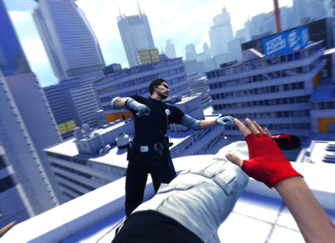
The trailer and demo, more than anything else, were different. It placed you in a shiny world alive with the colors white and red gleaming from all angles. Not that I mind the dreary colors of Gears of War, Bioshock, or Dead Space, but having to don shades to play Mirror's Edge is not a bad change of pace. Of course, once I played the game I realized how quickly wrong I was. However, that's not to say I was completely disappointed.
 Mirror's Edge puts you in the red running shoes of Faith, your Asian female protagonist. She delivers packages for the good people the government has wrongly thrown in jail. And apparently she has to deliver these packages via roof tops as the city is "highly monitored" by these evil corporations. However, who these people are or what is being delivered is never really explained, and this plot piece is quickly tossed aside as Faith gets caught up in a conspiracy involving her cop sister, Hope - er, Kate, a Wrestler running for mayor, double crosses by your fellow agency members, and about a million cops that have nothing better to do than chase you on rooftops with choppers in pursuit.
So ya, the plot isn't really there. At all. When you really get into it, its about as contrived a Steven Seagal movie. Actually that may be giving it too much credit, but still we don't watch those for the plot. Where the plot of Mirror's Edge may be contrived, the gameplay is what we came for.
While there is a terribly steep learning curve, once you've gotten a handle on it Mirror's Edge becomes a virtual parkour, or free-running, experience. It's different, especially since they take advantage of the first person shooter view-point in a way that, if you wanted, you don't have to fire a single weapon. However, the first person, while different, is also its crutch, as it limits your camera view to literally what you can see with your eyes. You'll spend several hours trying to jump to various buildings, only to fall several thousand feet to your death. Then you'll do it again. And again, and again.
Ironically, this is the most brilliant aspect of the game. As you control all your characters' movement - arms, legs, head - it comes oddly close to replicating a real experience (with the exception being that if this were real you probably would have died on your first plummet back down to earth).
 So does it stick? Its my first analysis and I'd like to be nice. But I'd have to say that the game sticks, then slowly falls, like missing a ledge and plummeting to its death for the umpteenth time.
Yet it should be noted that the game is highly original. It took the first person p.o.v. and did something holistically unique with it. In that sense it has something in common with Portal, it took a very worn game perspective and gave it a fresh dress to put on. However, in Mirror's Edge's case, the dress came with some holes. That's not to rule it out, their use of the first person should be remembered. If we were to take this and apply it to a first person shooter, where you had to make active use of your whole body while engaging in combat, we may create a game with a steeper learning curve, yet with a more, oddly realistic, perspective. Future developers should take note, as the experiment known as Mirror's Edge should not be looked at as failure, but rather a first trial, where many more are needed to perfect this new style of game play and presentation.